Powder, Liquid, Chewable, or Gummies: Which Animals Supplement Format Is Best for Your Market?
Compare powder, liquid, chewable, and gummy animals supplement formats for pets, horses, and livestock. Learn how to choose by dosage, stability, packaging, and market fit.
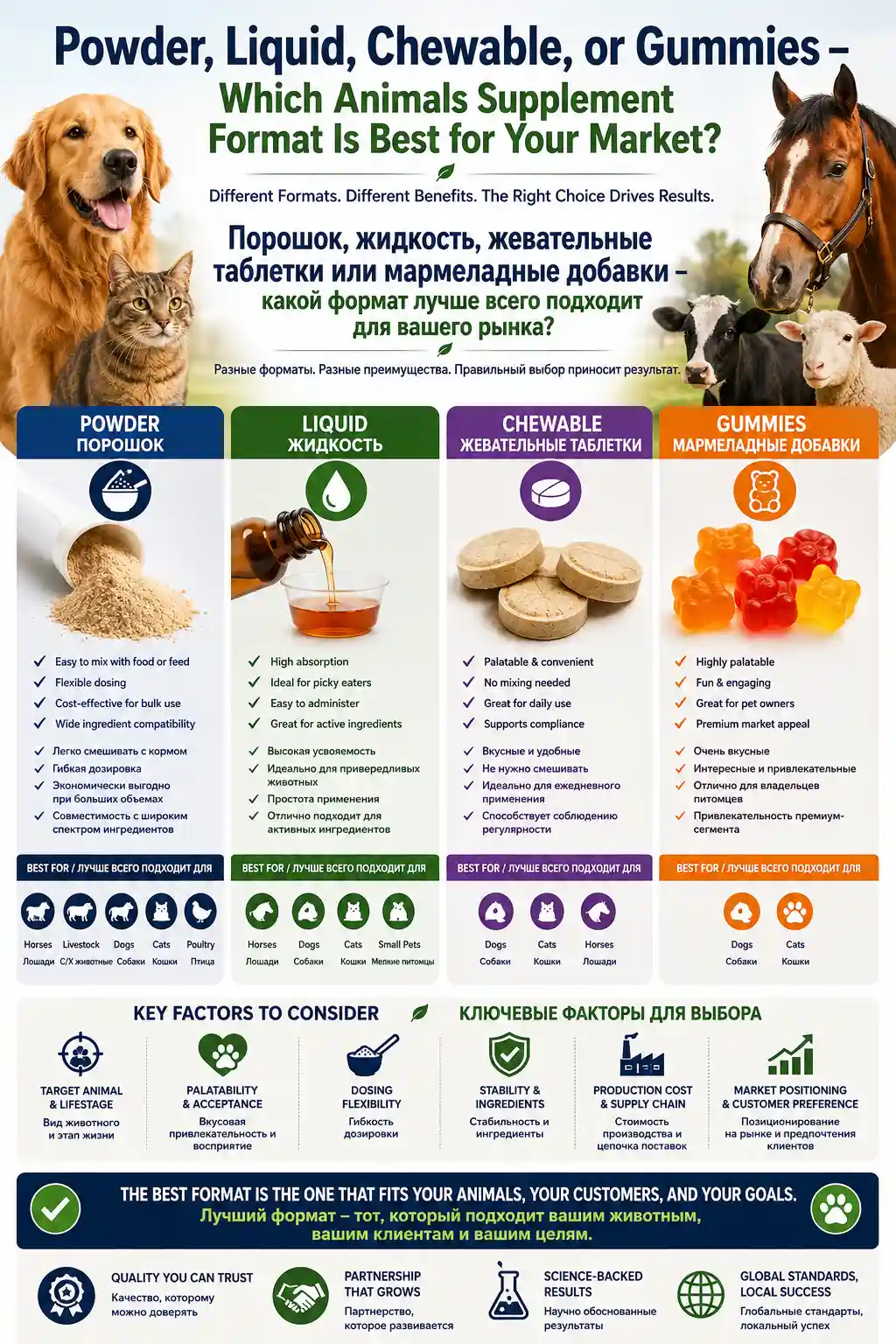
Choosing the right animals supplement format is not only a formulation decision. It affects dosage accuracy, shelf life, packaging cost, customer compliance, shipping efficiency, and repeat purchase. For brand buyers, wholesalers, and private label companies, powder, liquid, chewable, and gummy products each serve a different market logic.
The category is expanding because animal owners and professional buyers are paying more attention to daily wellness, mobility, digestion, skin and coat, calm support, and performance nutrition. Grand View Research estimated the global pet supplements market at about USD 2.76 billion in 2025 and projected it to reach USD 4.65 billion by 2033, with a 6.9% CAGR from 2026 to 2033. The broader veterinary dietary supplements market was estimated at USD 3.96 billion in 2025 and projected to reach USD 7.96 billion by 2033. In a growing market, format selection can decide whether a product is easy to sell, easy to use, and practical to manufacture.
Why Supplement Format Matters in the Animals Supplement Market
A strong animals supplement product starts with a clear use scenario. Is the formula designed for household pets, horse owners, livestock farms, veterinary channels, grooming stores, or online subscription sales? A dog joint supplement sold through e-commerce has different requirements from a cattle mineral support product used on a farm.
Format also changes how consumers understand value. A soft chew may feel convenient and premium for pet owners. A powder may look more economical for horses or livestock. A liquid may be preferred when flexible dosing is needed. A gummy may help a pet brand create a more familiar consumer-style product, but it also brings formulation and stability limits.
Powder Supplements: Best for Bulk Use, Feed Mixing, and Cost Efficiency
Powder is one of the most practical formats for animals supplement products, especially when the daily serving size is relatively large. It works well for horses, livestock, multi-pet households, and bulk wholesale orders. Powders can be mixed into feed, sprinkled over food, or packed into jars, pouches, sachets, or bulk containers.
From a manufacturing point of view, powder often offers good cost control and flexible formula capacity. It can carry probiotics, enzymes, minerals, vitamins, amino acids, botanical extracts, collagen, glucosamine, MSM, electrolytes, and fiber ingredients. However, buyers should check flowability, dust level, moisture control, flavor masking, and whether the active ingredients remain evenly distributed after blending.
Powder is usually a strong choice when the buyer values cost per serving, larger dosage, and operational practicality.
Liquid Supplements: When Fast Administration and Flexible Dosing Matter
Liquid supplements are useful when easy administration and adjustable dosing are important. They are often used for pets, horses, young animals, senior animals, or situations where tablets and hard formats are difficult to feed. Liquids can support formulas for skin and coat, digestion, hydration balance, energy support, or general wellness.
The main advantage is convenience. A liquid can be added to food or water, measured with a cap or syringe, and adjusted by animal weight. For cats or picky pets, a well-flavored liquid may be easier than a tablet.
The challenge is stability. Oils, emulsions, botanical extracts, and water-based systems require careful preservation, packaging, and shelf-life testing. Buyers should ask about viscosity, separation, sediment, microbial control, bottle material, leakage risk, and storage conditions. Liquids can be effective commercially, but they require tighter quality control than many dry formats.
Chewable Supplements: A Practical Format for Pet Brands and Daily Use
Chewables and soft chews are highly attractive for dog supplement brands because they combine nutrition with treat-like convenience. They are especially suitable for joint support, digestion, skin and coat, calming, immune wellness, and senior pet formulas. When the flavor is right, the product fits naturally into a daily routine.
For B2B buyers, chewables offer strong branding potential. Shape, texture, aroma, color, and packaging can all support a premium product position. They also allow clearer serving instructions, such as one chew per weight range.
Still, chewables are not simple. Heat sensitivity, moisture level, texture stability, palatability, and active ingredient loading must be reviewed carefully. Some ingredients have bitter notes or strong odors, while others may not tolerate certain processing conditions. A chewable format should be chosen when palatability and daily compliance are more important than maximum ingredient loading.
Gummies for Animals Supplement Products: Opportunities, Limits, and Buyer Expectations
Gummies are gaining attention because human supplement habits often influence pet product design. For some markets, gummies can look modern, friendly, and easy to understand. They may suit certain pet-focused formulas if the texture, flavor, sugar level, and serving size are properly controlled.
However, gummies are not suitable for every animal or every ingredient. They may have lower formula capacity than powders, and heat or moisture can affect sensitive ingredients. Texture can change during storage, especially in hot climates. Buyers must also consider whether the target animal can chew the product safely and whether the format is appropriate for the species.
For pet brands, gummies may be useful as a differentiated product line. For horses and livestock, they are usually less practical than powders, liquids, pellets, or feed additives.
How to Match Format with Animal Species, Channel, and Consumer Behavior
The best format depends on the animal and the selling channel. Dogs often perform well with soft chews, chewable tablets, powders, and oils. Cats may need powders, gels, liquids, or smaller chewable formats due to feeding behavior. Horses usually fit powders, pellets, pastes, and liquids. Livestock products are commonly delivered through feed premixes, water-soluble powders, mineral blends, or bulk liquids.
Channel also matters. E-commerce favors products that are visually clear, easy to explain, and safe to ship. Veterinary and professional channels may prefer accurate dosing and technical credibility. Farm buyers focus on cost, mixing convenience, and consistency.
Manufacturing, Stability, Packaging, and MOQ Factors Buyers Should Compare
Before choosing a format, buyers should compare MOQ, lead time, ingredient compatibility, stability testing, packaging options, label requirements, and unit economics. Powders may offer lower cost and flexible packing. Liquids need stronger leakage and preservation control. Chewables require texture and palatability testing. Gummies need careful control of moisture, heat exposure, and shape stability.
Packaging should match the product. Pouches reduce shipping weight. Bottles improve shelf presence. Sachets support trial packs. Tubs and bulk bags work better for professional or farm use.
Which Animals Supplement Format Is Best for Your Market?
There is no single best animals supplement format. Powder is often best for cost efficiency, larger servings, and feed mixing. Liquid is best when flexible dosing and easy administration matter. Chewable formats are strong for pet brands that need daily compliance and consumer appeal. Gummies may work for selected pet markets, but they need careful formulation and realistic expectations.
The right decision should come from the target species, ingredient load, dosage size, sales channel, packaging budget, and customer behavior. For long-term brand growth, the best format is the one that makes the supplement easy to understand, easy to use, stable on the shelf, and credible in its claims.
Data Sources
- Grand View Research, Pet Supplements Market Size, Share & Trends Report, 2025-2033.
- Grand View Research, Veterinary Dietary Supplements Market Size Report, 2025-2033.
Ready to start your private label pet supplement project? Contact WanZiBei Biotechnology to discuss your manufacturing requirements with our expert team.
Tags
Ready to manufacture your pet supplement?
Discuss your project with our expert team today.
Get a Quote