Animals Supplement Manufacturer vs. Trading Supplier: How to Find a Reliable Partner
Compare animals supplement manufacturers and trading suppliers. Learn how to evaluate production capability, quality control, MOQ, pricing, lead time, and long-term reliability.
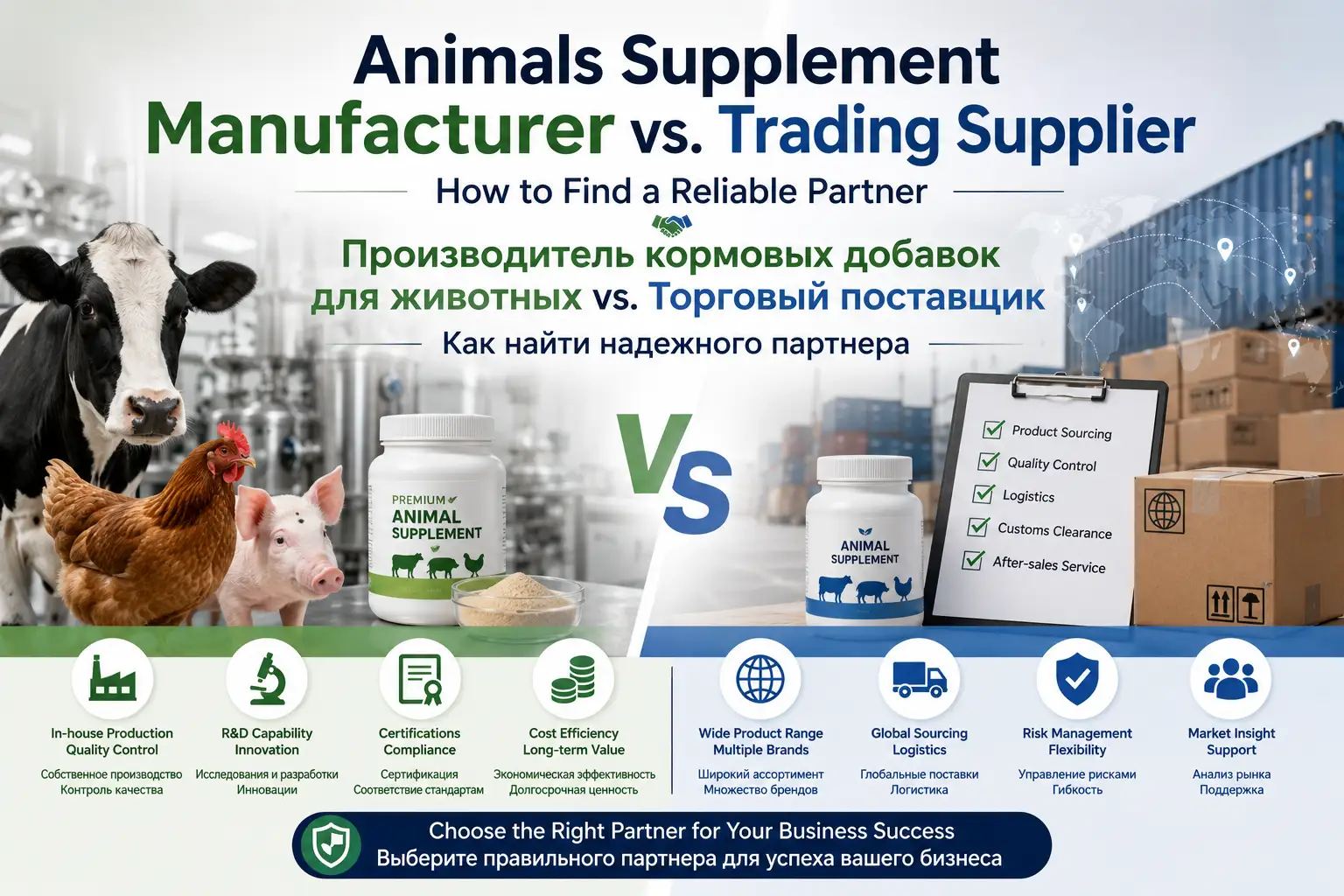
Choosing between an animals supplement manufacturer and a trading supplier is one of the most important decisions for wholesale buyers and private label brands. On the surface, both may offer similar products: powders, liquids, chewables, tablets, soft chews, or bulk animal nutrition formulas. In practice, their capabilities, responsibilities, pricing logic, and long-term value can be very different.
The decision matters because the animal supplement category is expanding quickly. Grand View Research estimated the global pet supplements market at about USD 2.76 billion in 2025 and projected it to reach USD 4.65 billion by 2033, with a 6.9% CAGR from 2026 to 2033. In the wider animal nutrition sector, the animal feed additives market was estimated at USD 44.42 billion in 2025 and projected to reach USD 67.26 billion by 2033. As demand grows, buyers need partners that can support stable quality, reliable delivery, and compliant product communication.
Why Supplier Type Matters for Wholesale and Private Label Buyers
A manufacturer usually owns or directly manages production. This means they can provide deeper technical information about formulas, production process, ingredient sourcing, batch control, and packaging options. For buyers who need custom animals supplement products, this direct connection is valuable because formula adjustments, flavor testing, dosage changes, and sample revisions can be handled more efficiently.
A trading supplier, on the other hand, normally sources products from one or more factories and sells them to buyers. A good trading supplier can still be useful, especially when buyers need ready-stock products, small mixed orders, or quick access to multiple categories. However, traders may have limited control over production schedules, formula details, and long-term consistency.
For wholesale buyers, the question is not simply “factory or trader?” The better question is: which supplier type fits your current business model? A reseller testing a new market may value speed and variety. A brand owner building a private label line needs deeper manufacturing support and repeatable quality.
How to Evaluate Production Capability, Formula Support, and Quality Control
When evaluating an animals supplement manufacturer, ask practical production questions. What formats do they produce in-house? Can they make powders, liquids, tablets, soft chews, or only one product type? Do they have experience with dogs, cats, horses, poultry, cattle, or multi-species formulas? Can they explain how ingredients are weighed, mixed, tested, packed, and stored?
Formula support is another key point. A capable manufacturer should be able to discuss active ingredient levels, palatability, species suitability, shelf life, and packaging compatibility. For example, probiotic powders require attention to moisture and heat exposure. Soft chews require texture stability and flavor control. Liquids require sealing, preservation, and transport safety.
Quality control should not be treated as a slogan. Buyers should ask about raw material checks, in-process control, finished product inspection, batch coding, retained samples, and shelf-life testing. If a supplier cannot explain these steps clearly, the buyer may face problems later during repeat orders.
Pricing, MOQ, Lead Time, and Communication: What Buyers Should Compare
Price is important, but it should not be the only basis for choosing a supplier. A very low quotation may hide weak packaging, unstable ingredients, unclear documentation, or poor after-sales support. Buyers should compare the full commercial picture: unit price, minimum order quantity, sample cost, packaging cost, lead time, payment terms, shipping support, and reorder stability.
MOQ should be realistic for your sales stage. A manufacturer may require a higher MOQ for custom formulas because raw materials, production setup, packaging, and testing all create fixed costs. A trading supplier may offer lower MOQ for ready-stock products, but customization options can be limited.
Communication speed is also a real business factor. In B2B procurement, delayed replies often become delayed samples, delayed production, and delayed shipping. A reliable partner should answer technical questions with detail, confirm timelines clearly, and warn buyers early if there are risks around ingredients, packaging, or delivery.
When a Manufacturer Is the Better Choice for Custom Animals Supplement Products
A manufacturer is usually the better choice when the buyer wants a private label or custom animals supplement line. This includes custom formulas, branded packaging, flavor development, different serving sizes, special active ingredient levels, or product positioning for a specific animal group.
Manufacturers are also better suited for long-term brand building. If you plan to sell the same product for several years, batch consistency and technical continuity matter. A direct manufacturer can help adjust formulas based on market feedback, improve packaging after the first production run, and support scale-up when sales increase.
Another advantage is transparency. A manufacturer should be able to provide more direct answers about production capacity, quality checks, ingredient origin, and formulation limits. This does not mean every manufacturer is automatically reliable, but it gives serious buyers more room to verify capability.
When a Trading Supplier May Be Suitable for Ready-Stock Wholesale Orders
A trading supplier may be suitable when the buyer needs speed, product variety, or smaller initial quantities. For example, a distributor testing animal supplement products across several markets may want joint support chews, probiotic powders, calming liquids, and multivitamin tablets without committing to a custom formula for each SKU.
Trading suppliers can also be helpful when buyers need consolidated sourcing. Some traders work with multiple factories and can combine different products into one order. This can save time for small buyers who are still learning the market.
However, buyers should be careful. Ask whether the trading supplier can provide product specifications, ingredient lists, shelf-life information, batch details, and packaging options. If they cannot answer basic product questions or must “ask the factory” for every detail, the buyer should consider whether the communication chain is too long for a serious supplement business.
How to Choose a Reliable Long-Term Partner for Animals Supplement Business
The best supplier is the one that matches your business stage and risk tolerance. If you are testing demand, a trading supplier with ready-stock products may help you move faster. If you are developing a private label animals supplement brand, a manufacturer with formula support and quality control is usually the stronger choice.
Before placing an order, request samples, review packaging, check label language, confirm documentation, and ask for a clear production timeline. Avoid exaggerated claims such as “cures disease” or “guaranteed treatment effect.” Responsible suppliers should use support-based wording, such as “supports joint mobility,” “supports digestive health,” or “helps maintain normal skin and coat condition.”
A reliable partner does not only sell products. They help reduce risk. In animals supplement, that means stable production, honest communication, species-appropriate formulas, practical packaging, and repeatable quality. For buyers planning long-term growth, those factors are more valuable than saving a few cents on the first order.
Data Sources
- Grand View Research, Pet Supplements Market Size, Share & Trends Report, 2025–2033.
- Grand View Research, Animal Feed Additives Market Size & Industry Report, 2025–2033.
Ready to start your private label pet supplement project? Contact WanZiBei Biotechnology to discuss your manufacturing requirements with our expert team.
Tags
Ready to manufacture your pet supplement?
Discuss your project with our expert team today.
Get a Quote