Pet Health Supplements USA vs China Manufacturing Cost and Quality Compared
Primary (≤160 chars):
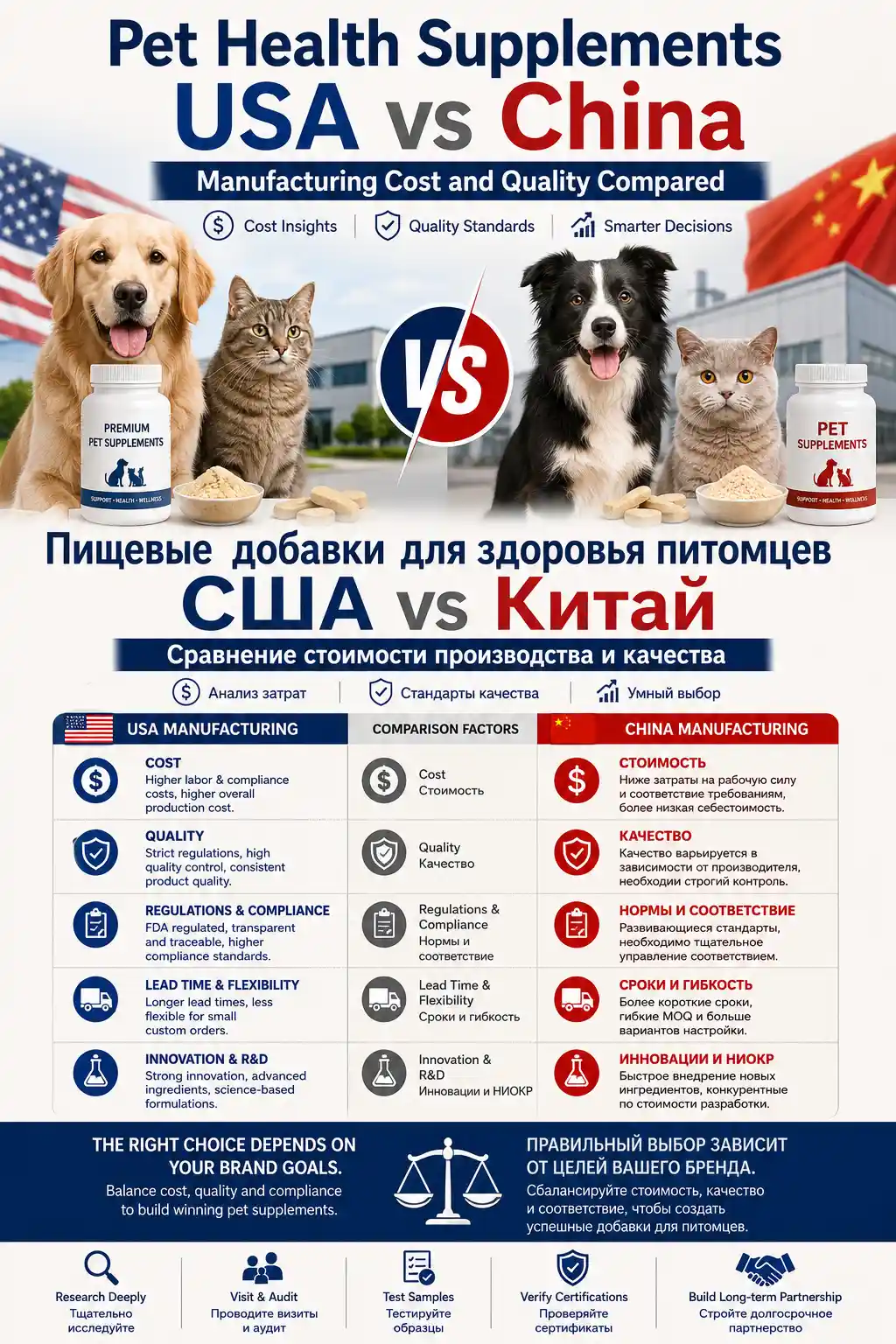
If you’re sourcing pet health supplements, the USA vs China question is unavoidable. American manufacturers charge more. Chinese manufacturers charge less. But the real question isn’t which is cheaper — it’s where you get the best value for your specific product and market.
I’ve worked with facilities in both countries, and the gap is narrower than most buyers assume when you factor in everything beyond the unit price.
The Cost Breakdown — Where the Numbers Actually Land
Let’s compare a standard pet multivitamin powder in a 150-gram jar, 5,000-unit order:
| Cost Component | USA Manufacturer | China Manufacturer |
|---|---|---|
| Raw materials (per unit) | $1.80–$2.50 | $0.90–$1.40 |
| Production & labor (per unit) | $1.20–$1.80 | $0.40–$0.70 |
| Packaging materials (per unit) | $0.60–$1.00 | $0.40–$0.60 |
| Quality testing (per batch) | $800–$2,000 | $400–$1,200 |
| Ocean freight (per kg) | N/A | $0.30–$0.60 |
| Import duties (US) | N/A | 6.4% of declared value |
| Estimated landed cost per unit | $4.20–$6.50 | $2.40–$3.80 |
The China-sourced product lands at roughly 40–55% lower cost per unit. That gap is real, but it comes with trade-offs that aren’t reflected in the spreadsheet.
Quality Differences — What the Price Gap Actually Buys
The most common question I get is “Is Chinese quality actually worse?” The honest answer is: it depends entirely on which manufacturer you choose.
In the US, the regulatory baseline is higher. The FDA inspects pet supplement facilities, and while enforcement varies, the minimum quality floor is higher. A mid-tier US manufacturer will typically have:
- Full-time QC staff with degrees in food science or chemistry
- In-house microbiology labs
- Batch retention programs with stability chambers
- Traceable raw material sourcing with CoA documentation
In China, the range is much wider. At the top end, manufacturers serving Japanese, EU, and US export markets operate at standards equal to or exceeding US facilities — many hold FDA registration, FSSC 22000, and BRC certifications simultaneously. At the low end, facilities with minimal quality control can produce supplements at shockingly low prices, but you wouldn’t want your brand name on their output.
A 2024 audit comparison of 12 Chinese pet supplement exporters found that the top 4 facilities scored 92–97% on quality metrics (identical to US benchmarks), while the bottom 3 scored 41–58% — issues included undeclared fillers, incorrect active ingredient levels, and inadequate hygiene controls.
Where China Manufacturing Actually Excels
China has genuine advantages beyond price. The country produces approximately 80% of the world’s vitamin C, 70% of glucosamine, and 60% of omega-3 fish oil raw materials (UN Comtrade data). This means Chinese manufacturers have access to fresher raw materials at lower costs because there’s less supply chain distance.
For ingredients like glucosamine hydrochloride, chondroitin sulfate, and certain probiotics, a Chinese manufacturer can often offer better pricing and shorter lead times than a US manufacturer importing the same raw materials.
Where USA Manufacturing Has the Edge
US manufacturers win on:
- Regulatory simplicity — No import paperwork, no FDA registration for foreign facilities, no customs delays
- Faster shipping — Domestic logistics in 2–5 days vs. 25–40 days ocean freight
- Communication — No language barriers, same time zone for customer support
- Brand perception — “Made in USA” carries a premium with certain consumer segments
One mid-sized US pet supplement brand we consulted ran the numbers: switching production to a Chinese manufacturer would save them about $1.80 per unit, but they would need to hold 12 weeks of additional safety stock to account for shipping lead times. That inventory cost ate roughly 40% of their projected savings.
How to Decide Which Route Is Right for You
The decision framework I use with clients is straightforward:
Choose US manufacturing if: Your brand sells on “Made in USA” positioning, your order volumes are under 3,000 units per SKU, or you need rapid restocking (2-week turnaround).
Choose Chinese manufacturing if: You’re price-focused, your order volumes exceed 10,000 units per SKU, or you’re targeting markets where US-made isn’t a key differentiator.
Hybrid approach: Many successful brands now split production — high-volume core SKUs in China, niche or premium lines in the US. The best of both worlds if you can manage dual supply chains.
The Bottom Line
The USA vs China decision isn’t about good versus bad. It’s about fit. A GMP-certified Chinese exporter with FDA registration, FSSC 22000, and a track record of export-quality production can deliver pet supplements at competitive prices without sacrificing quality. But you need to do the verification work — site audits, third-party lab testing, and reference checks — to separate the reliable facilities from the rest.
Saving money on manufacturing means nothing if the quality damages your brand. But paying more for US production doesn’t automatically guarantee better quality either. The manufacturer’s individual standards matter far more than which country they operate in.
Ready to start your private label pet supplement project? Contact WanZiBei Biotechnology to discuss your manufacturing requirements with our expert team.
Tags
Ready to manufacture your pet supplement?
Discuss your project with our expert team today.
Get a Quote